
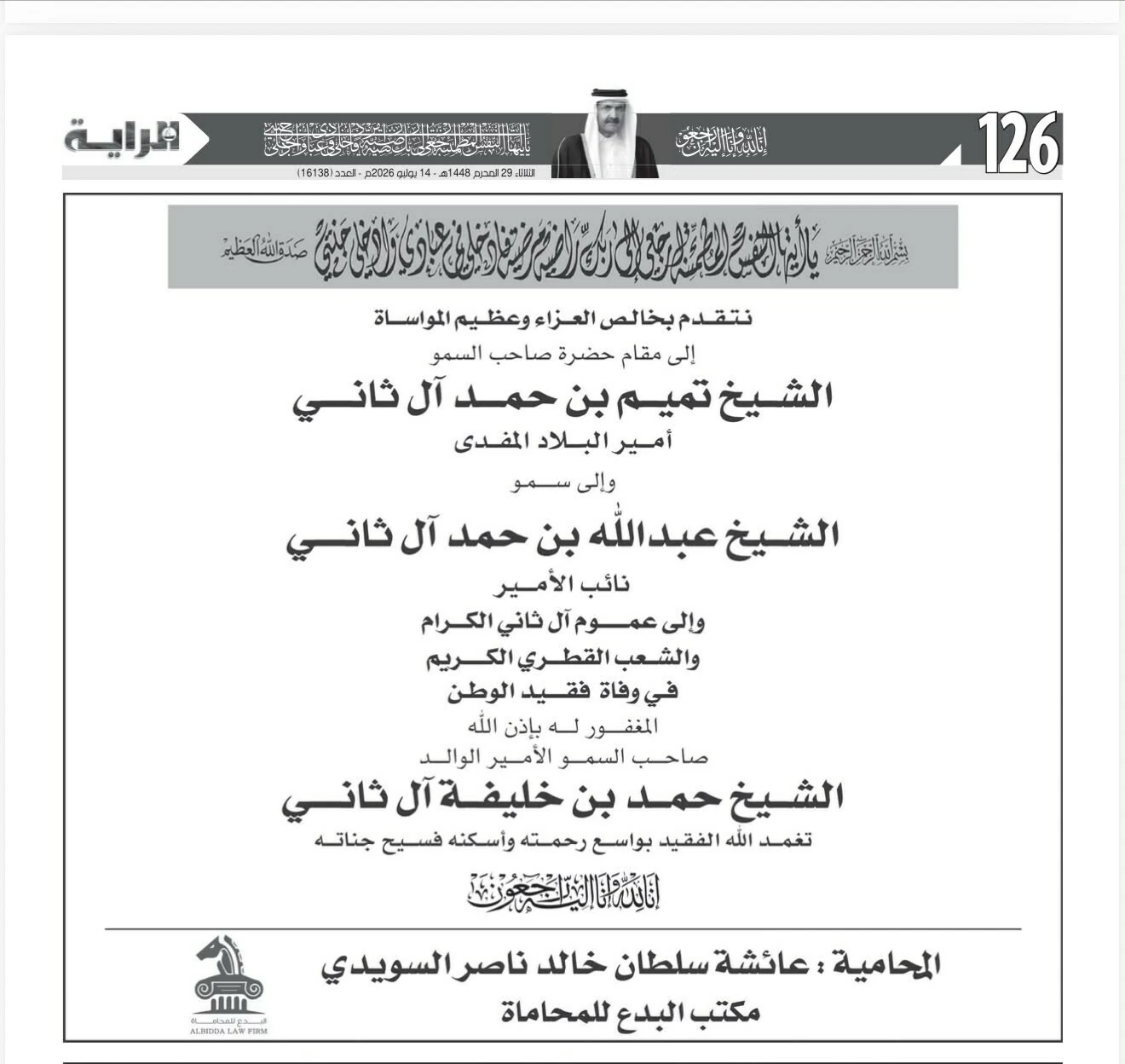
On the morning of Sunday, 12 July 2026, as Doha was still breathing in its quiet calm, the news arrived—light as a footstep, yet heavy as a mountain: His Highness the Father Amir Sheikh Hamad bin Khalifa Al Thani had passed away.
At Imam Muhammad ibn Abdul Wahhab Mosque, where his grieving people gathered to perform the funeral prayer, the sorrow seemed greater than the courtyards could contain. It was not merely the farewell of an Amir, but the farewell of an entire chapter in the nation’s history—a leader whose presence remained woven into the details of our lives, who laid the foundations of a modern state confident in its standing and proud of its identity. That blessed journey continues today under the wise, steadfast, and capable leadership of His Highness Sheikh Tamim bin Hamad Al Thani, Amir of the State. And because true progress is measured by the dignity it grants to every individual, the Father Amir did justice to all the sons and daughters of his nation. Qatari women, in particular, found in his era a rightful place in the national vision and a well-deserved role in the country’s journey of development.
His commitment to women was never a passing promise nor a slogan reserved for special occasions; it became a reality that unfolded before our eyes.
On 8 March 1999, Qatari women stood before the ballot box as both voters and candidates in the Central Municipal Council elections. That moment was far more than the casting of a ballot—it marked the opening of a new chapter in the nation’s history and sent a clear message that a woman’s voice is an integral part of Qatar’s voice, and that she is a partner in public affairs and in shaping the future, not merely an observer of its progress.
Women later stood alongside men in the referendum on the Permanent Constitution in 2003, taking part in a defining national moment and contributing their voices to the constitutional framework of their country’s future. From the ballot box, the path extended to positions of responsibility, and Qatari women became ministers, members of the Shura Council, judges, public prosecutors, diplomats, and leaders in academic and economic institutions—not as guests on the national stage, but as genuine partners in shaping it.
In education, the doors of universities and world-class academic institutions within Qatar were opened to Qatari women. Dreams of becoming doctors, engineers, lawyers, researchers, and diplomats were no longer beyond reach; they became open paths pursued with confidence, grounded in identity, inspired by the legacy of their mothers, and directed toward an even broader future.
Alongside him, Her Highness Sheikha Moza bint Nasser was the beating heart of this human-centered vision. She championed education and the empowerment of people, making knowledge the path to dignity, independence, and meaningful participation. As a result, Qatari women became doctors, engineers, academics, diplomats, lawyers, judges, and leaders—not because they abandoned their identity, but because they found a homeland that believed in their abilities and opened the way before them.
Herein lies the true greatness of the Father Amir’s vision for women: he never regarded them as one half waiting for someone to grant them their place. Rather, he saw them as the other half of the nation, without whom no nation can be complete, partners in responsibility whose contribution to raising the nation’s flag is no less significant than that of men.
Perhaps the truest feeling I can express today is that we, the sons and daughters of this nation, never felt that we merely lived under a government. We felt that Qatar had both a father and a mother: a father who charted the course and laid the foundations, and a mother who carried the torch of education and humanity. Together, they gave the nation two wings with which to soar—a man and a woman working side by side, sharing equally the honor and responsibility of nation-building.
Today, as we bid farewell to the father, grief weighs heavily upon our hearts. Yet we find solace in knowing that his legacy remains, that the seeds he planted have blossomed into a nation, and that the enduring foundations he established continue to guide Qatar today under the leadership of His Highness Sheikh Tamim bin Hamad Al Thani, Amir of the State, toward ever greater prosperity and distinction.
As for me, every time I see a photograph of the Father Amir, I will feel that a part of our childhood and our collective memory still stands there—reminding us of a man who was never merely a passing figure in Qatar’s history, and reassuring us that the journey continues and that the nation remains in good hands.
The Father Amir has departed, but the nation he helped build, the women in whose role he believed, and the generations who opened their eyes to his vision will forever bear witness to the fact that some leaders do not see their legacy end with their passing; rather, they begin a new life in the memory of their nations.
May Allah have mercy upon the Father Amir, Sheikh Hamad bin Khalifa Al Thani, forgive him, grant him the highest place in Paradise, and reward him abundantly for all that he gave to Qatar and its people. May Allah preserve His Highness Sheikh Tamim bin Hamad Al Thani, Amir of the State.
May Allah also preserve Her Highness Sheikha Moza bint Nasser Al-Missned, and grant the honorable Royal Family and the loyal people of Qatar patience, solace, and strength in this time of loss.
Indeed, to Allah we belong, and to Him we shall return.
**Daughter of the Nation, Lawyer Aisha Sultan Khalid Nasser Al-Suwaidi**